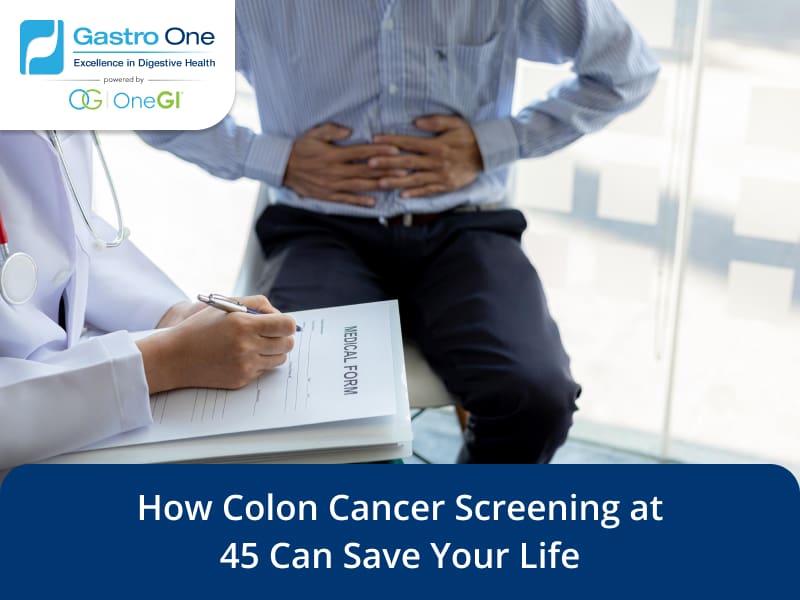
If you are turning 45, congratulations on hitting an important milestone! While you might be celebrating with family or planning your next big goal, there is one crucial health milestone you should not overlook: it is time to begin screening for colon cancer.
At Gastro One, we believe in colon cancer awareness and know that thinking about cancer screening isn’t exactly fun. But it is one of the most powerful preventive tools we have in modern medicine.
Let’s talk about why 45 is the new 50 when it comes to your health!
Table of Contents
What is Colon Cancer Screening and Why Does It Matter?
When we talk about saving lives, we aren’t exaggerating. Colon Cancer Screening is unique because it not only catches cancer early but can also prevent it from developing in the first place.
To understand why this is a literal lifesaver, you need to understand how colon cancer develops. Most colorectal cancers start as small, noncancerous clumps of cells called polyps. Over several years, these polyps can quietly turn into cancer. During a screening, a specialist can find these polyps and remove them before they ever have a chance to cause trouble.
Colon cancer screening saves lives by finding and removing precancerous polyps before they turn into cancer, and by detecting early-stage cancer when it is up to 90% treatable.
A Changing Trend: Why the Colon Cancer Screening Age Dropped to 45
For generations, many people assumed that colon cancer was an “older person’s disease.” Unfortunately, medical data shows a shifting trend. While colorectal cancer cases are dropping in older adults, thanks to regular checkups, cases are steadily rising in people under the age of 50.
Medical studies highlight some eye-opening realities:
- Colorectal cancer is now the leading cause of cancer-related death in adults younger than 50 when men and women are combined.
- Since roughly 2005, deaths from colorectal cancer have increased by about 1% per year in younger adults.
- Shockingly, about three out of four adults under age 50 who are diagnosed with colorectal cancer already have advanced disease by the time they see a doctor.
Because colon cancer often develops silently without any early symptoms, waiting for warning signs like rectal bleeding, persistent abdominal pain, or unexplained weight loss can mean waiting too long.
In response to this growing trend, the U.S. Preventive Services Task Force and the American Cancer Society officially lowered the recommended colon cancer screening age from 50 to 45. Research proved that a 45-year-old today faces the same statistical risk of developing colorectal cancer as a 50-year-old did back in the 1990s. For a deeper look at the data driving this change, see our top colon cancer prevention 7 reasons to screen at 45.
How Screening for Colon Cancer Protects You
At Gastro One, our medical team focuses on two main goals when performing a screening for colon cancer:
- True Prevention: Finding and removing polyps can entirely interrupt the progression of cancer. Removing these growths reduced colorectal cancer deaths by 53% over 20 years.
- Early Detection: If cancer is already present, catching it early means treatment is highly effective and drastically improves long-term survival rates.
Regularly scheduling your colon cancer screening reduces your overall risk of dying from the disease by approximately 50%. It is one of the single most effective health habits you can adopt.
Why a Colonoscopy is the Gold Standard
When researching your options, you will find several methods, including at-home stool tests. However, a colonoscopy remains the most comprehensive method available, and it’s what we specialize in here at Gastro One.
| Screening Feature | Colonoscopy | Stool-Based Tests (FIT / DNA) |
|---|---|---|
| Advanced Polyp Detection Rate | 89% – 95% accuracy | 23% – 43% accuracy |
| Immediate Treatment | Yes (Polyps removed on the spot) | No (Requires a follow-up colonoscopy if positive) |
| How Often You Need It | Once every 10 years (if results are normal) | Every 1 to 3 years |
While stool tests are acceptable for some patients, they only flag signs of a problem. If an at-home test comes back positive, you will still need a follow-up colonoscopy to find out why. A colonoscopy combines detection and prevention into one single, highly accurate procedure.
Who Needs to Get Checked at 45?
The guideline to begin colon cancer screening at age 45 applies to anyone at average risk. You fall into this category if you have no personal or family history of colon polyps or cancer, and no inflammatory bowel disease (like Crohn’s or ulcerative colitis).
However, you are considered high risk and may need to start even earlier if you have:
- A first-degree relative (parent, sibling, or child) diagnosed with colorectal cancer or advanced polyps.
- A personal history of inflammatory bowel disease.
- Known genetic conditions like Lynch syndrome.
Important Rule of Thumb: If you have a first-degree relative with a history of colon cancer, medical guidelines recommend starting your screenings at age 40, or 10 years before the age your relative was diagnosed, whichever comes first.
Overcoming the “Screening Gap”
Despite a clear medical consensus, a major “screening gap” exists. Only about 20% of adults aged 45–49 are currently up to date with their recommended exams.
Why is this number so low? Many young adults feel completely healthy and assume they don’t need to worry about it. Others feel anxious about the preparation process or the procedure itself.
Moving from awareness to action means pushing past these anxieties and recognizing that early detection is your absolute best defense. At Gastro One, we understand those anxieties, and we design our care to be as comfortable, private, and stress-free as possible. The modern preparation liquids taste better than they used to, and the procedure itself is performed under light sedation, meaning you will sleep right through it and won’t feel a thing. A few hours of inconvenience deliver up to a decade of continuous peace of mind.
Take Action: Partner with Gastro One
Don’t wait for symptoms to appear before prioritizing your health. At Gastro One, we offer comprehensive gastrointestinal disease diagnosis, treatment, and care right here in your community. Our expert clinical team is dedicated to guiding you through every step of the process with empathy, clarity, and top-tier medical expertise.
If you are 45 or older, taking charge of your digestive health is one of the bravest and smartest choices you can make for your future. Contact our team today to schedule your consultation for a professional Colon Cancer Screening. Let’s work together to keep you healthy for all the milestones yet to come.
Frequently Asked Questions
What symptoms should prompt a doctor’s visit before a scheduled screening?
You should evaluate symptoms immediately if you experience persistent changes in bowel habits, unexplained weight loss, constant abdominal cramping, weakness, fatigue, or visible rectal bleeding, rather than waiting for a routine preventive screening appointment.
Can I drink clear liquids up until the exact moment of my colonoscopy?
No. While clear liquids are essential during preparation, you must stop consuming all fluids, including water, for a specific number of hours before your appointment. This timeline ensures a safe sedation process for your procedure.
What is the difference between a screening and a diagnostic colonoscopy?
A screening colonoscopy is a preventive procedure performed in patients without symptoms to detect hidden polyps. A diagnostic colonoscopy is performed to investigate existing symptoms, such as unexplained bleeding, chronic abdominal pain, or abnormal stool tests.
Can I undergo a colonoscopy if I have active hemorrhoids?
Yes. Having hemorrhoids does not prevent you from getting a colonoscopy. Our Gastro One specialists can safely perform the procedure around them, and the examination can help confirm whether rectal bleeding is coming from hemorrhoids or a deeper tissue issue.