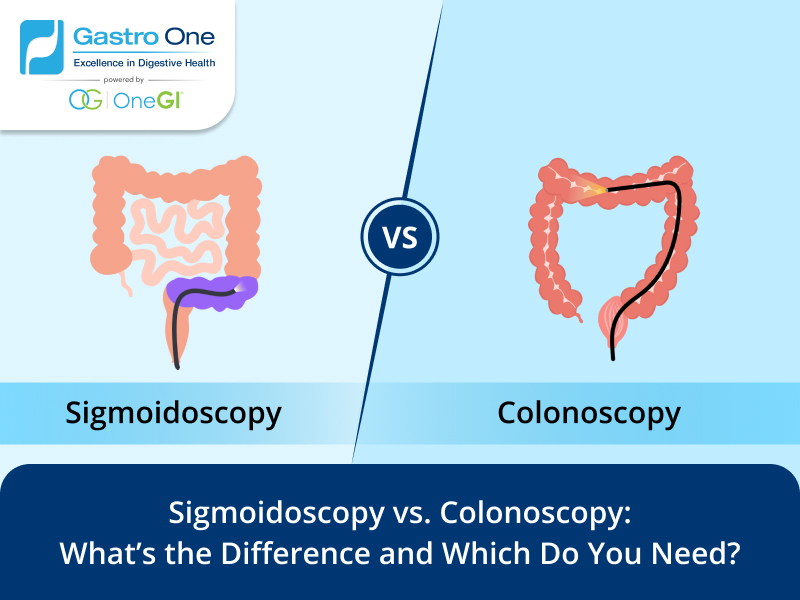
Colorectal cancer can develop without early warning signs, which makes screening especially important. If your doctor mentions a sigmoidoscopy or colonoscopy, it helps to understand the differences between them. A colonoscopy examines the entire colon and rectum, while a sigmoidoscopy checks only the lower part. That difference affects preparation, sedation, recovery, and the completeness of the exam.
In this guide, we explain how each procedure works, when it may be recommended, what it can detect, and how to better understand which option may fit your screening needs.
Table of Contents
Sigmoidoscopy vs. Colonoscopy: The Main Difference at a Glance
Sigmoidoscopy vs. Colonoscopy differ mainly in how much of the colon each test examines, as well as in preparation, sedation, and overall scope.
| Aspect | Colonoscopy | Sigmoidoscopy |
| Area examined | Examines the entire large intestine, including the rectum and all sections of the colon | Examines only the lower part of the colon, usually the rectum and sigmoid colon, and sometimes part of the descending colon |
| Scope of evaluation | Provides a full view of the colon | Provides a partial view of the colon |
| Screening value | Considered the most complete visual screening test for colorectal cancer | Useful, but does not check the full colon |
| Invasiveness | More extensive procedure | Less invasive procedure |
| Overall experience | More comprehensive but typically more involved | Simpler, often quicker, and easier to tolerate |
Why Colorectal Cancer Screening Matters and Why You Must Get It Done in March
Colorectal cancer screening matters because it can detect cancer early and even help prevent it. Many colorectal cancers begin as polyps, which can often be found and removed before they become more serious. Screening is especially important because early-stage colorectal cancer may not cause noticeable symptoms, so people may feel fine while changes are developing.
Cases in younger adults have also increased, which is why screening now begins earlier for many people. March, recognized as Colon Cancer Awareness Month, is the perfect time to take action. If you are due for screening, this month is a timely reminder to schedule it and prioritize your health.
When Should You Start Colorectal Cancer Screening?
- Adults at average risk should begin colorectal cancer screening at age 45.
- Routine screening generally continues through age 75.
- For adults aged 76 to 85, screening decisions should be based on overall health, prior screening history, and personal preference.
- Some people may need screening earlier or more often if they have higher risk factors.
- Higher-risk factors include a family history of colorectal cancer, prior polyps, inflammatory bowel disease, or hereditary syndromes.
- Symptoms like rectal bleeding, bowel changes, or unexplained weight loss should not be ignored at any age.
What Is a Colonoscopy?
A colonoscopy is a procedure that allows a doctor to examine the inside of the entire colon and rectum using a long, flexible tube called a colonoscope. The scope has a small camera and light at the end, allowing the doctor to view the lining of the colon on a monitor.
How a Colonoscopy Works
During the procedure, the colonoscope is inserted through the anus and guided carefully through the rectum and the full length of the colon. Air or gas is used to expand the colon so the doctor can see clearly. As the scope moves through and is slowly withdrawn, the doctor checks for anything abnormal.
Because it examines the full colon, colonoscopy is considered the most thorough visual exam for colorectal screening.
What a Colonoscopy Can Detect
- Polyps
- Colorectal cancer
- Inflammation
- Ulcers
- Bleeding
- Diverticular disease
- Bowel obstructions
- Structural abnormalities
- Signs of Crohn’s disease or ulcerative colitis
What Is a Sigmoidoscopy?
A sigmoidoscopy is a procedure used to examine the lower part of the colon, especially the rectum and sigmoid colon. It uses a shorter flexible tube with a camera, often called a sigmoidoscope.
How a Sigmoidoscopy Works
Like a colonoscopy, a sigmoidoscopy involves inserting a thin scope through the anus. However, the scope only travels through the lower portion of the large intestine. Air may be used to improve visibility.
Because the exam covers less distance and uses a shorter scope, it is usually quicker and less invasive than a colonoscopy.
What a Sigmoidoscopy Can Detect
- Polyps in the lower colon
- Tumors
- Hemorrhoids
- Ulcers
- Inflammation
- Sources of rectal bleeding
- Lower-colon changes linked to ulcerative colitis or Crohn’s disease
- Diverticular issues affecting the lower colon
It may also be used to monitor people who have had previous issues involving the rectum or left side of the colon.
Colonoscopy vs. Sigmoidoscopy: What Are the Key Differences?
Although both procedures are used to look inside the colon, they differ in several important ways.
When Is a Colonoscopy Usually Recommended?
- Rectal bleeding
- Chronic diarrhea or constipation
- Persistent abdominal pain
- Blood in the stool
- Unexplained weight loss
- An abnormal stool test
- A personal history of polyps
- A personal history of colorectal cancer
- Inflammatory bowel disease
- A family history of colorectal cancer
- A hereditary colorectal cancer syndrome
When Is a Sigmoidoscopy Usually Recommended?
- Rectal bleeding
- Blood or mucus in the stool
- Changes in bowel movements
- Constipation or diarrhea
- Belly pain
- Itching around the anus
- Low iron or low blood counts
- Follow-up of known lower-colon or rectal issues
How to Prepare for a Colonoscopy vs. Sigmoidoscopy
Colonoscopy Preparation
A colonoscopy prep requires a full bowel cleanse, including diet changes, clear liquids, and bowel prep solutions or laxatives.
Sigmoidoscopy Preparation
Sigmoidoscopy usually requires less extensive preparation, often involving an enema or lighter cleansing method.
What Are the Pros and Limitations of Colonoscopy vs. Sigmoidoscopy?
Benefits of Colonoscopy
Provides a complete view of the colon and allows immediate removal of polyps.
Limitations of Colonoscopy
Requires more preparation, sedation, and recovery time.
Benefits of Sigmoidoscopy
Quicker, less invasive, and often does not require sedation.
Limitations of Sigmoidoscopy
Does not examine the entire colon.
Flexible Sigmoidoscopy vs. Colonoscopy: Which Test Is Right for You?
Flexible sigmoidoscopy vs. colonoscopy mainly differ in how much of the colon each test examines. Colonoscopy is more complete, while sigmoidoscopy is quicker and more targeted.
Which Test Do You Need?
- Your age
- Your symptoms
- Your personal and family history
- Your risk level
- Your past screening results
- Your overall health
- Your comfort with sedation and bowel prep
- Your doctor’s recommendation
What Are the Other Colorectal Cancer Screening Options?
- FIT (yearly at-home stool test)
- Stool DNA testing (every 1–3 years)
- CT colonography (every 5 years)
Key Takeaways
- A colonoscopy examines the entire colon and rectum.
- Sigmoidoscopy checks only the lower colon.
- Colonoscopy is preferred for full screening.
- Sigmoidoscopy is useful for targeted concerns.
- Timely screening is essential.
Conclusion
When comparing sigmoidoscopy vs. colonoscopy, the biggest difference is how much of the colon each test examines. A colonoscopy offers the most complete view and remains the best option for full colorectal cancer screening.
If you are 45 or older, now is the time to take action. Do not delay screening that could protect your long-term health. Talk to the team at Gastro One about scheduling your colonoscopy.
FAQs
Which is better for colorectal cancer screening?
Colonoscopy is generally better because it evaluates the full colon.
Can a sigmoidoscopy detect colon cancer?
Yes, but only in the lower colon.
What happens if something abnormal is found?
A follow-up colonoscopy is usually recommended.
At what age should screening begin?
Typically, at age 45 for average-risk adults.
Who may need earlier screening?
People with higher risk factors, such as family history or prior conditions.